Wednesday, October 31, 2007

A (not so old) favourite


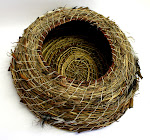
This morning I stumbled across this beautiful, little, dyed pandanus basket in one of my 'places to keep special things'. I remember that I bought this basket in Krabi, but am thinking it must have been 10 years ago, which was well before I began working with natural fibres. Anyway, I estimate that I have moved homes a good 15 times in the last ten years so am impressed that the little basket and I are still together.

Pandanus leaves and this style of weaving are used by women in Southern Thailand; my mother-in-law used to work like this (before she became addicted to daytime TV) and used to always have pandanus drying under and around her house. Most of the older women I know in Krabi have skills in preparing and weaving pandanus for floor mats and I have seen in some of the Urak Lawoi (sea gypsy) communities I have been to, that pandanus weaving is still very much alive. Unfortunately though, so many places in Southern Thailand have become overrun with tourism and invaded by Tescos and Macros that artforms like these and traditional weaving skills are rapidly being lost.

Tuesday, October 30, 2007

Art/craft debate


On the footpath outside Chatuchak market; whichever way you swing on the art/craft debate, these are great.

Friday, October 26, 2007

Transmigration

Some recently completed works from my Transmigrate series.


Tuesday, October 23, 2007

Burma

Burma has been dominating the headlines the past few weeks. Heavy fisted Than Shwe and his cronies have once again silenced opposition to their regime with violence and blood.

http://www.irrawaddy.org/

In 1993, I became good friends with Ma Khin Mar Mar Kyi (Mar) when we moved into the same house in Bangkok. I had just finished a privledged and exciting backpacking experience around India and Mar had just been forced to leave her home, family and friends in Rangoon and become a political refugee from Burma. Same age, same time, same roof, different lives. Through her personal history, Mar educated (educates) me about the social and political climate that lead to the 8/8/88 political uprisings throughout Burma and the oppression in Burma that continues today. In 1995 Mar migrated to Australia and is now a well recognised Burmese scholar in Australia, researching and working with victims of trafficking, migrant workers and stateless children.

Last year Mar made a presentation Hidden Stories: Cost of Burmese militarization on women and children at Parliament House in Canberra.

Mar and I speak at least weekly and she helps me to understand the complexities and challenges of life for the Burmese, both those inside Burma and those who live in exile. For me it is hard to understand why Burma's neighbours can't just pull together and expel Burma from ASEAN or why the Security Council cannot place Burma higher on it's list of priorities? I know it not as simple as this, but it is frustrating to see it take so long to bring change to Burma. On the other hand, in 1988 very few people in the international community knew what was happening inside Burma. This week, despite the tragic events, it has been great to see the widespread media coverage of Burma.


This is a picture I took of Mar in 2002 when we protested at Parliament House in Canberra, Australia on the 15th anniversary of the 1988 political uprising in Rangoon.


Mar and I in Laos around 1998.

Wednesday, October 10, 2007

Bird Nest Stadium


I have been reading about Chinese artist Ai Weiwei and his design for the Beijing National Stadium which will be used for the 2008 Olympics. It was conceived as a large vessel; like a bird's nest with interwoven twigs. I love how the facade and structure are the same thing with the structural elements mutually supporting each other. Also interesting to see how the open, unenclosed structure provides for natural ventilation - nature's solution to sustainable design.

The Beijing Olympics, of course, are full of controversy with widespread reports of forced evictions and demolition of houses to allow for the rapid redevelopment of Beijing make way for construction projects for the games.

Recently Ai Weiwei has stated that he will boycott the Olympic Games and will not allow himself to be associated with either the government or the games. In the article below Ai Weiwei states, "I very openly criticise the tendency to use culture for the purpose of propaganda, to dismiss the true function of art and the intellect."

Olympic artist attacks China's pomp and propaganda

Tuesday, October 9, 2007

Coming Soon - Asiatopia

In a few weeks the 9th Asiatopia (Performance Art Festival) will be held in Chiang Mai, accompanied by The Southeast Asian Performance Art Symposium 2007. I'm looking forward to seeing some new art and am particularly keen to seen performance works from Burma.

I was looking at the logo for the 7th Asiatopia festival in 2005 - and thought it was a funny coincidence that it was 'dedicated to all chickens and birds who died of Avian Flu in Asia and the rest of the world' .

Kinaree

Kinaree line drawing and sculpture at Suvarnabhumi Airport in Bangkok.

Lately I've become a bit obsessed with all things birds.

Kinaree (in Thai กินรี) is a half bird-half female creature from Hindu and Buddhist mythology who inhabits the legendary himmapan forest. Her upper half is human form and lower half is similar to a bird which allows her to fly between the human and mythical words. Kinaree is said to be the 'traditional symbol of feminine beauty, grace and accomplishment'.

Di·as·po·ra

Di·as·po·ra (dī-ās'pər-ə)

[Greek diasporā, dispersion, from diaspeirein, to spread about : dia-, apart; see dia- + speirein, to sow, scatter; see sper- in Indo-European roots.]

Monday, October 8, 2007

Birds, H5N1 and Irony

Lately I have started a new series of work.

It is nesting season and I have been noticing lots of the most beautifully detailed and delicate Scaly-breasted Munia lonchura punctulata nests on my verandah and in the trees around our apartment in Chiang Mai. Being a weaver, I can't help but admire the materials and structure of these amazing forms. Apart from this, birds serve as a metaphor for the migratory experiences of families like mine that move between different parts of the world, and nests as the temporary and fragile resting places that we construct, abandon and sometimes reclaim along the way.


Moving back and forth between 3 very different cultural spheres allows me to look at experiences and people around me in a somewhat detached and analytic way. I spend part of my year in the coastal, suburban area where I grew up in Queensland, Australia, another part living in a community of Thais and expatriates from all parts of the world in Chiang Mai and a third part in the coastal Muslim community in which my husband grew up in Krabi, Southern Thailand.

I have always thought it fascinating how birds are able to move between spaces and places, carrying seeds in their bellies and shitting them out in a new environment, facilitating the spread of plant species and creating new 'hybrid' environments, much like the diaspora of communities of people around the world who fertilize new cultural spheres.
Besides all this, birds and the beautiful nests they craft, are simply an awesome aspect of our natural environment!

I have been considering this in relation to the current fear of birds surrounding H5N1 (Asian Bird Flu) and the potential that exists for a global influenza pandemic. This hit home last week when I rushed a friend to a hospital ER with a very high fever and we were hit with a barrage of questions about birds and our contact with them. I though immediately to one of my favourite daily rituals - an early morning cup of tea on my verandah watching the birds going about their business and feeling very special to have them nesting right on my doorstep.

It turns out that my friend only had Leptospirosos (yes, the rat urine bacteria!) but the interrogation in the ER prompted me think about the irony of something so alluring and liberated as birds being such a threat. I started this series of new work with this in mind.

Recently I stumbled across a fabulous pack of coasters with kitsch bird designs on them and am using the coasters as the base of these works and constructing onto them with finely split bamboo that the rice farmers around Chiang Mai use to tie bundles of rice together.

Sunday, October 7, 2007

Measuring Up


Last year I gave in ! Sick of the Great Australian Rental Scam, I signed away and took out the dreaded lifelong bank mortgage for my first home. Each month, on Repayment Day I think of all the (other) things I could do/would rather do with money ...

Anyway, when I was in Brisbane in June, I went in one of those ridiculously large
Ikea stores full of mass-produced goods from China, oops I mean Sweden. The whole material culture is just insane - the (in)security of massive home loans (and always increasing interest rates - thanks Howard), the need to fill hard-earned homes with shit you don't really use and certainly don't need.  Ikea's slogan - affordable solutions for better living.


I didn't buy anything from Ikea but instead 'acquired' some of the lovely little paper measuring tapes they give you as you walk around the store to make sure everything you buy fits just right. Lately I have been shredding the measuring tapes and random weaving with them. No easy feat! 

I am playing with the idea of nests paradoxically as security and fragility.


I love how these have turned out! Initially I was worried that structurally these forms were weak and tried other weaving techniques; later realising that the lack of structural support in these forms provided a perfect metaphor for the whole mythology of home ownership/living in debt to the bank. It is also an appropriate comment on the fragile lives of so many that are affected by free markets and labour exploitation by multinationals corporations.

Anyway, not sure where these pieces/ideas are headed, for now they are sitting around brewing.

Random Weaving


One technique that I often use in my work is random weaving which is just how it sounds - a construction technique where the material is simply woven back into itself.

It's a very spontaneous way to work and often the materials dictate the final form. I constructed this piece from Banglow Palm stalks back in 2003.

Saturday, October 6, 2007

Tibetan Art


Leslie and Terris Nguyen Temple are two friends of mine who have trained in traditional Tibetan thangka art techniques. Their studio, Temple Art Studios, is based in Chiang Mai, Thailand and they are involved in some absolutely amazing art projects to restore aspects of Tibetan culture, following the invasion of Tibet in the 1960s.


They are commisioned to co-ordinate the production of silk and brocade appliqué thangkas, often replicas of works which have been destroyed during the invasion. This image is of a 35 x 24 meter silk appliqué which they worked on in the 1990s and is housed at Tsurphu Monastery. I love the scale of this work ! I can't even get my head around how big that actually is, let alone how it possibly could be constructed (Leslie tells me in a very large gym, with many hands and under the auspicious eyes of Venerable Drupon Dechen Rinpoche, Abbott of Tsurphu Monastry). 1,500 meters of silks and brocades, 70 shades of colour, 70 workers and 2 years!

Leslie is also my yoga teacher and every Monday night manages to twist my body into all sorts of pretzel shapes.

Friday, October 5, 2007

Cabbages and Condoms


When in Bangkok recently I had a meal at Cabbages and Condoms, a restaurant in the grounds of the Population and Community Development Association which was set up Thai politician and social activist Mechai Viravaidya, commonly known as 'Condom Man'. The restaurant decor leans heavily towards the use of condoms and contraception pill packs out of which light shades and wall decorations are made. I particularly loved the Mona Lisa with her cheeky smile and Durex, and this fabulous safe-sex haute couture.

Worth a visit if you are ever in Bangkok. Sukhumvit Soi 12.

To Plastic or Not to Plastic ?


For a few years I have been working with predominantly natural fibres that I find in the environment around me. Sometimes, however, I look around at the local markets that I shop at and I am overhelmed by the sheer amount of plastic that is around me - vessels of all shapes and sizes and in a wide range of fabulous colours. Thailand - Land of Smiles (and Plastic).

I have been playing around with some new media - the plastic threads that are used to make Scoobies. A few years back I remember that the teenage kids I taught were almost fanatical about making these things.(I just had a look on the net to see whether I was spelling that correctly and found in fact they can be called scoubidous, scoubi, scoobie, boondoggles, lanyards or gimps!)


Anyway, I came across some packs of the plastic threads and it got me thinking about fads, and how their short-lived fame has such a long-lasting impact on the environment. I have been playing around with the threads, random weaving with them and enjoying their bright and alluring colours.

Thursday, October 4, 2007

Weekend in Bangkok

Still recovering from my huge weekend in Bangkok! Managed to catch a load of great exhibitions and of course, didn't see half of what I wanted to.

One of the highlights of the weekend was Cambodian artist Sopheap Pich's exhibition Tidal at H Gallery. Beautiful, large-scale rattan pieces that made me want to jump inside them. I was particularly interested in the references to Khmer history and society and the connection between to the artworks and Sopheap's experience of surviving genocide to become a refugee as a child, moving to the US, and then returning to Cambodia as an adult.


This piece was inspired by Tonle Sap and it's unique tidal system (at different times of the year, water flows both down and upstream from the lake). There was also a fabulous installation of rattan dogs which appeared to be partly submerged in water; a nice play on perspective using the gallery wall to represent the surface of the water.


Another highlight of the weekend was Confectionaries and Conurbations an exhibition which an old mate of mine Steve Pettifor has recently curated. Fabulously colourful and playful work by 2 female, Asian, disaporic artists - Tiffany Chung and Chila Kumari Burman.

100 Tonson Gallery is one of my favourite Bangkok galleries (largely because of the exhibitions and artists they choose to represent and also because it is one of the few galleries not inside a Bangkok shopping mall!); definately worth a look if you are in Bangkok.


Steve Pettifor and I arrived in Bangkok around the same time in 1992 and became part of a circle of friends. While I have jumped in and out of the kingdom in the time since then, he has remained firmly on Thai soil and has carved out a niche for himself as a Bangkok-based art writer and curator. A few years back he published the text Flavours - Thai Contemporary Art which gives a good overview of some of the more recognised Thai artists. He puts together a monthly Bangkok Art Map (BAM) which can be picked up in galleries around town - a great publication to get your hands on as just so much art to check out in Bangkok. Great to catch up with him after a number of years; he gave an informative talk to my students about curatorial and art-writing work and the artists represented in Confectionaries and Conurbations.


Also caught a great show of contemporary Indian art Here and Now at Soulflower gallery and Chiang Mai-based Kamin Lertchaiprasert's latest offerings at Tang Contemporary Art Gallery. Some fabulous work.

An exhibition I really enjoyed was Hoopla Loop at Art Republic, a colourful exhibition of 3 young Chaing Mai artists, Luck Maisalee, Artid Poonyasiri and Torlarp Larpjaroensuk.

Unfortunately the weekend was cut short by a horrible bout of Leptospirosis (yes, the rat urine disease!) as a friend who was with me had to be hosptalised after catching this nasty bug on a white water rafting trip the previous weekend. So, I spent the next few days check out the watercolours which wallpaper the halls of Bumrungrad Hopsital in Bangkok.... anyway, this trip reminded me what an exciting city for contemporary Asian art Bangkok is and I have started making plans for another trip in a few weeks.

Sunday, September 23, 2007

Heading to the Big Mango


This weekend I am crawling out of my cocoon in quiet Mae Rim, outside Chiang Mai and heading off to Bangkok to check out some exhibitions with a group of 12 students that I teach.

Bangkok is the 22nd most populous city in the world. I remember the first time I visited Bangkok in 1992, it was just after the Black May coup d'etat and between the heavy military presence outside my hotel near the Democracy Monument, the humidity of June and the dense traffic, I wondered how people managed to survive and stay sane. My short trip to Asia, turned into an extended working holiday in Bangkok and some 3 years later I finally left Bangkok - I had survived but was decidedly less sane. I moved back to Bangkok in 2000 for 2 years and now love to visit, but think my days of gridlock traffic jams are over!

Anyway, I am looking forward to a weekend with lots of art, great food, some new inspiration and a bit of shopping. I am not sure whether the thought of going away with a group of 17 year old art students for a weekend makes me feel younger than I am or a lot older. In any case, its bound to be an interesting weekend.

Saturday, September 22, 2007

Art and Chiang Mai

I spend most of my year in Chiang Mai and feel fortunate to be able to take advantage of the thriving art scene in this little part of the world.


This weekend I decided to stay in town and used the opportunity to visit a few of my favourite art galleries. I checked out the lastest offerings at Chiang Mai University Art Museum and then headed up Nimmenhamen Road to a great little art gallery called Ji-Qoo which is run by Thai artist Chatchawan Nilsakul and his lovely Japanese wife Satoru.

The image below is of some of Chatchawan's work - bands of oil paints with raw convas underneath onto which watercolour bleeds - delicious stuff! If you are ever in Chiang Mai, it's worth checking out Ji-Qoo - some awesome work (mainly staff and students from CMU); its in a beautiful building and a happening part of town.


Friday, September 21, 2007

John Dahlsen

My recent work with beach debris has been inspired by the work of John Dahlsen . This is one of his works titled Catch 3.

A few years ago on Clean Up Australia Day I heard him talk about his work at the beautiful Tweed Regional Art Gallery. He spoke about the process of collecting materials and the way the sea transforms and shapes debris into beautiful forms.

Recently I've been working with rusted fishing tackle, discarded ropes and snagged fishing line found on the beach and interweaving these materials with natural fibres also found along the coast. As with Dahlsen I am interested in the wearing down of materials by natural forces and the process of collecting materials. I enjoy the colours and textures of rusted tackle and old ropes and enjoy the physical contact with materials.

Thursday, September 20, 2007

Flying Arts Regional Art Award


This is a work that I've recently completed for the Flying Arts Regional Art Awards . I worked on this piece in July while staying on the north coast of NSW. Having just come from the sticky monsoon of Northern Thailand, we were absolutely freezing and while Noo spent most of his days fishing on the Tweed River and Fingal beach, I fossicked around for materials and found an exciting array of both natural fibres and discarded fishing materials. Fresh out of waxed linen, I used fishing line to stitch this coiled work. It's called Tum Ma Ha Gin (Thai translated as 'work for food') and is a response to the challenges that coastal fishing communities face. Noo comes from a small fishing community in Krabi in Southern Thailand that over the past 15 years, I've watched be literally swallowed whole by tourism under the TAT's 'Amazing Thailand' campaign. 12 million per year! Hmmm amazing alright....

Friday, September 14, 2007

Dragon Trees

Dracaeno Draco (or Dragon Tree) is a beautiful subtropical tree which drops leaves with the most amazingly colourful and exquisite stalks. I began experimenting with the stalks a few years ago. This piece was made from a variety of fibres woven into a frame made of wisteria vine.


The Dracaena draco is native to the Canary Islands and the trees have a great umbrella-shaped canopy. There is a beautiful tree in Brisbane City Botanical Gardens up on the hill near the cafe which was planted in 1862 (some specimen are beleived to be over 600 years old).

I collected the leaves for my work from underneath a Dragon Tree in the carpark of Humble Pies at Billinudgel (north coasters will know exactly where I mean). The trick is to collect the leaves not too long after they have fallen and faded from the sun.

Apparently, the common name Dragon Tree comes from ancient Roman and mediaeval magic and alchemy. The reddish resin that the tree secretes when cut is known as dragon's blood, and is believed by some to be the dried blood of dragons. The coloured resin has been used as a varnish and dye, as well for a variety of medicinal and sharmanistic purposes.

The use of dragon's blood is documented across a wide range of cultures and its long list of uses has included violin varnish, toothpaste, incense, ink, as an antiviral and a coagulant, for chest pains, menstrual irregularities, eczema and ulcers, to stop post-partum bleeding, for diarrhea, for increasing the potency of spells in witchcraft and even as a great material for making baskets!

Sunday, September 2, 2007

Swell Sculpture

Its about time for the annual Swell Sculpture Festival to open on the beautiful Currumbin beachfront in Australia. This time last year I was working frantically to complete this piece for Swell.

It is called 'Currumbin Chedi' and I began the original sketches for this work when I returned to Australia after a trip to Thailand in December 2004 when the tsunamis hit the Andaman coast. We were near the beach at Ao Nang, Krabi getting ready to take the boys out for a day snorkeling when the waves hit.
I spent the next totally surreal 10 days translating at Krabi hopsital and at a the makeshift morgue which had been set up in Krabi town. In Krabi 740 people died. I still need to pinch myself that it even happened.
This piece was dedicated to all the Burmese migrant workers who were working on hotel construction in the area and whose bodies were not able to be collected by their loved ones. See Asian Human Rights Commission.

This work is made from a variety of fibres and standing at almost 2 meters, was challenging in terms of structure and scale. It is the result of a few months of very late nights and aching hands.

Anyway, if you are in the Currumbin area, drop into Swell and look out for Lindy Davidson's work because it is always awesome.

Saturday, August 25, 2007

Older work

A few weeks ago I spent an afternoon with a photographer friend and had some work photographed (thanks Jo!). I pulled out a collection of some of my favourite pieces and had them properly documented; the resulting photos are a vast improvement on my own!
Last year, I attended a seminar at Craft Queensland 'Best Foot Forward' which provided some strategies for documenting and presenting artworks and I have been having a go at photographing my own work. The results haven't been bad but time constraints (the demands of my teaching work and 2 young sons) meant that it always seemed a rushed job.
So, what a treat it was to drop Jonah and Ollie at mums and spend the afternoon with Jo, being bossy about what I wanted and enjoying spending time handling and looking at works that had been stored away for some time. I felt all soppy and nostalgic as each work held memories of the landscape that the fibres were collected from (we have arrived home from many road trips with the back of the car full to overflowing with an assortment of treasures found on the side of the road - much to my excitment and Noo's frustration). Anyway here's a few of the results.


Saturday, August 18, 2007

Natural Pigments


Process is an important part of artmaking for any artist. I often find I gain more enjoyment from sourcing, gathering and preparing materials, than I do from actually creating works. An artist who really interests me in terms of his process is Yanawit Kungchaethong.

Yanawit, who currently teaches at Silpakorn University in Bangkok, trained as a printmaker but grew concerned about the chemcials which prevail in printmaking studios and began investigating ways of making coloured pigments from a wide variety of plant species (among them pandanus, mangosteen and kum-ngo) found in Thailand. This painting above was produced from pigments derived from mango, chrysanthenum and butterfly pea plants.

A few months ago I had a chance to hear him speak about his research into plants and pigments at a talk he gave at Chiang Mai University as part of The Mekong Art and Culture Project.


What I found particularly interesting about his work was that Yanawit's father is a horticulturalist who grows plants for use in herbal medicine on the family's property at Petchaburi. Through his research into pigments, Yanawit has been able to inherit family knowledge of local resources that perhaps would otherwise have been lost. I was also interested to hear that he found the same plant produces different hues depending on the season in which it is harvested, which is what I have found when working with natural fibres. Working directly from the natural environment, seasonal cycles have a direct effect on what materials are available and how they appear and can be used.

Anyway, I found these works refreshing and have found a kum ngo tree growing near my office. My husband told me that his mother and grandmother used to squeeze the red berries to make lipstick and nail colour. I snuck out of my office one day recently to experiment with the kum ngo tree and had to get around the whole day looking and feeling ridiculous with bright reddish-orange lips that didn't wear off until much later that day.

Friday, August 17, 2007

First Time Ever!


This is my first ever blog so it's all very exciting! I've been inspired by late night wanderings on the net and have started this blog to document my visual arts practice and humble observations of the world around me.

I have been working as a visual artist since graduating from the Bachelor of Fine Arts at Southern Cross University in Lismore, Australia in 1992 and my work has evolved through a variety of media, across a number of countries and despite a succession of 'day jobs'.

For the past 4 years I have been working predominantly with natural fibres and have posted this coiled piece made from Kangaroo Grass (Themeda triandra) and stitched with waxed linen. The colours of Kangaroo Grass can be awesome and the long, resilient fibres make it an ideal material for coiling.