In a few weeks the 9th Asiatopia (Performance Art Festival) will be held in Chiang Mai, accompanied by The Southeast Asian Performance Art Symposium 2007. I'm looking forward to seeing some new art and am particularly keen to seen performance works from Burma.
Kinaree line drawing and sculpture at Suvarnabhumi Airport in Bangkok. 
Moving back and forth between 3 very different cultural spheres allows me to look at experiences and people around me in a somewhat detached and analytic way. I spend part of my year in the coastal, suburban area where I grew up in Queensland, Australia, another part living in a community of Thais and expatriates from all parts of the world in Chiang Mai and a third part in the coastal Muslim community in which my husband grew up in Krabi, Southern Thailand.
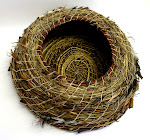
I have always thought it fascinating how birds are able to move between spaces and places, carrying seeds in their bellies and shitting them out in a new environment, facilitating the spread of plant species and creating new 'hybrid' environments, much like the diaspora of communities of people around the world who fertilize new cultural spheres.
Besides all this, birds and the beautiful nests they craft, are simply an awesome aspect of our natural environment!
I have been considering this in relation to the current fear of birds surrounding H5N1 (Asian Bird Flu) and the potential that exists for a global influenza pandemic. This hit home last week when I rushed a friend to a hospital ER with a very high fever and we were hit with a barrage of questions about birds and our contact with them. I though immediately to one of my favourite daily rituals - an early morning cup of tea on my verandah watching the birds going about their business and feeling very special to have them nesting right on my doorstep.
It turns out that my friend only had Leptospirosos (yes, the rat urine bacteria!) but the interrogation in the ER prompted me think about the irony of something so alluring and liberated as birds being such a threat. I started this series of new work with this in mind.
Recently I stumbled across a fabulous pack of coasters with kitsch bird designs on them and am using the coasters as the base of these works and constructing onto them with finely split bamboo that the rice farmers around Chiang Mai use to tie bundles of rice together.

I didn't buy anything from Ikea but instead 'acquired' some of the lovely little paper measuring tapes they give you as you walk around the store to make sure everything you buy fits just right. Lately I have been shredding the measuring tapes and random weaving with them. No easy feat!
I am playing with the idea of nests paradoxically as security and fragility.


I have been playing around with some new media - the plastic threads that are used to make Scoobies. A few years back I remember that the teenage kids I taught were almost fanatical about making these things.(I just had a look on the net to see whether I was spelling that correctly and found in fact they can be called scoubidous, scoubi, scoobie, boondoggles, lanyards or gimps!) Anyway, I came across some packs of the plastic threads and it got me thinking about fads, and how their short-lived fame has such a long-lasting impact on the environment. I have been playing around with the threads, random weaving with them and enjoying their bright and alluring colours.

This piece was inspired by Tonle Sap and it's unique tidal system (at different times of the year, water flows both down and upstream from the lake). There was also a fabulous installation of rattan dogs which appeared to be partly submerged in water; a nice play on perspective using the gallery wall to represent the surface of the water.
Another highlight of the weekend was Confectionaries and Conurbations an exhibition which an old mate of mine Steve Pettifor has recently curated. Fabulously colourful and playful work by 2 female, Asian, disaporic artists - Tiffany Chung and Chila Kumari Burman.
100 Tonson Gallery is one of my favourite Bangkok galleries (largely because of the exhibitions and artists they choose to represent and also because it is one of the few galleries not inside a Bangkok shopping mall!); definately worth a look if you are in Bangkok.
Steve Pettifor and I arrived in Bangkok around the same time in 1992 and became part of a circle of friends. While I have jumped in and out of the kingdom in the time since then, he has remained firmly on Thai soil and has carved out a niche for himself as a Bangkok-based art writer and curator. A few years back he published the text Flavours - Thai Contemporary Art which gives a good overview of some of the more recognised Thai artists. He puts together a monthly Bangkok Art Map (BAM) which can be picked up in galleries around town - a great publication to get your hands on as just so much art to check out in Bangkok. Great to catch up with him after a number of years; he gave an informative talk to my students about curatorial and art-writing work and the artists represented in Confectionaries and Conurbations.
Also caught a great show of contemporary Indian art Here and Now at Soulflower gallery and Chiang Mai-based Kamin Lertchaiprasert's latest offerings at Tang Contemporary Art Gallery. Some fabulous work.
An exhibition I really enjoyed was Hoopla Loop at Art Republic, a colourful exhibition of 3 young Chaing Mai artists, Luck Maisalee, Artid Poonyasiri and Torlarp Larpjaroensuk.
Unfortunately the weekend was cut short by a horrible bout of Leptospirosis (yes, the rat urine disease!) as a friend who was with me had to be hosptalised after catching this nasty bug on a white water rafting trip the previous weekend. So, I spent the next few days check out the watercolours which wallpaper the halls of Bumrungrad Hopsital in Bangkok.... anyway, this trip reminded me what an exciting city for contemporary Asian art Bangkok is and I have started making plans for another trip in a few weeks.

I spend most of my year in Chiang Mai and feel fortunate to be able to take advantage of the thriving art scene in this little part of the world. 
My recent work with beach debris has been inspired by the work of John Dahlsen . This is one of his works titled Catch 3.

The Dracaena draco is native to the Canary Islands and the trees have a great umbrella-shaped canopy. There is a beautiful tree in Brisbane City Botanical Gardens up on the hill near the cafe which was planted in 1862 (some specimen are beleived to be over 600 years old).
I collected the leaves for my work from underneath a Dragon Tree in the carpark of Humble Pies at Billinudgel (north coasters will know exactly where I mean). The trick is to collect the leaves not too long after they have fallen and faded from the sun.
Apparently, the common name Dragon Tree comes from ancient Roman and mediaeval magic and alchemy. The reddish resin that the tree secretes when cut is known as dragon's blood, and is believed by some to be the dried blood of dragons. The coloured resin has been used as a varnish and dye, as well for a variety of medicinal and sharmanistic purposes.
The use of dragon's blood is documented across a wide range of cultures and its long list of uses has included violin varnish, toothpaste, incense, ink, as an antiviral and a coagulant, for chest pains, menstrual irregularities, eczema and ulcers, to stop post-partum bleeding, for diarrhea, for increasing the potency of spells in witchcraft and even as a great material for making baskets!
Its about time for the annual Swell Sculpture Festival to open on the beautiful Currumbin beachfront in Australia. This time last year I was working frantically to complete this piece for Swell.